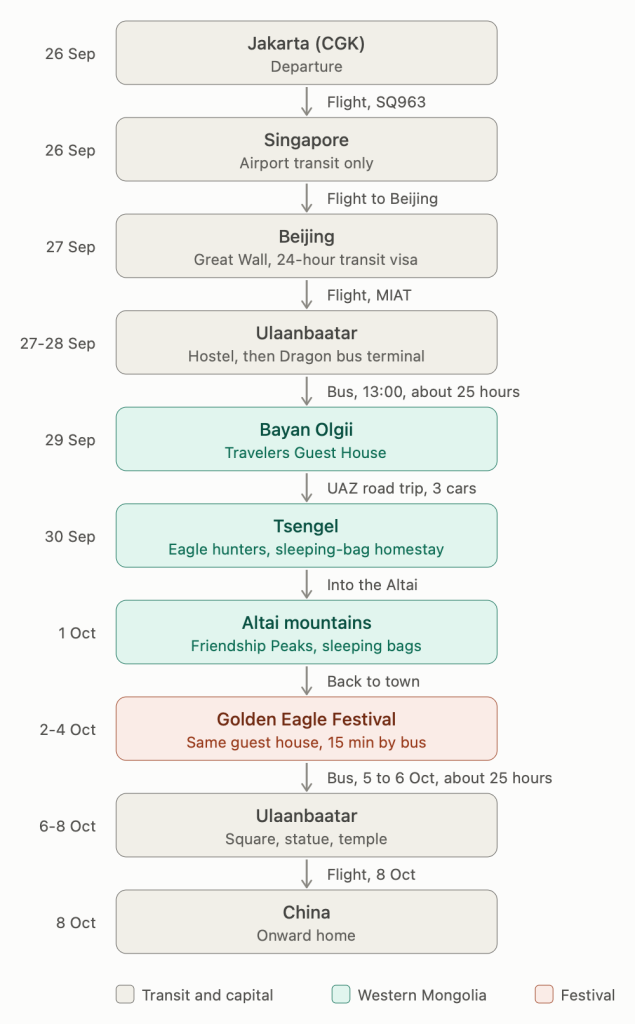
I travelled to western Mongolia from 26 September to 8 October 2026, right as the Altai gets cold. Between a 25-hour bus ride, homestay nights in a sleeping bag, and an open trip that told me to pack in a carrier instead of a suitcase, I had to pack warm and light. The limits were 25 kg on Singapore Airlines and 20 kg on MIAT. I left Jakarta with 16 kg and came home with 12 kg.
How cold was it, really?
The coldest it got was about 5°C. It never went below zero, and there was no snow. The cold that people warn you about is the wind. On a calm moment 5°C is fine, but with wind on the open steppe it felt far colder than the number.
Clothes
Three Heattech tops
Two Heattech leggings
One Jeans
Two usual pants
Two outer shirts (yellow, blue floral)
One sleeping outfit
Underwear
Uniqlo puff jacket
Raincoat (serious one, from Eiger).
Layers of Heattech and thermal were enough for me, and the clothes and pants I packed were enough for the whole trip.
When it’s very windy, I use both the puff jacket and the raincoat, with gloves, beanies, and neck warmer. And I did survived.
Feet and accessories
Three pairs of Heattech socks
Pashmina, gloves, and a neck warmer
Two beanies
A crossbody bag for sightseeing
The gloves, beanies and the neck warmer did the most work against the wind.
Toiletries
Shampoo and conditioner, bar soap, 12 sachets of detergent
A washcloth (waslap) and a travel towel
Toothbrush and toothpaste
Dry and wet tissues
Sunscreen, lip balm, and night cream
A waterproof bag for wet items
Perfume and deodorant
During the two days in the Altai (30 September and 1 October), I didn’t shower at all. There was no water at all, and it was so cold that nobody noticed. If you’re going to a homestay out there, accept that now.
One strip of cold medicine and one strip of motion-sickness tablets
Omega 3, magnesium, glucosamine, and vitamin C
Mouth tape for sleeping
My regular prescription medication
This is where I was short. The dust in the Altai is something else, and I came home with a cold and a cough (no fever). I wish I had packed more cough medicine and cold tablets. I am ok during the bus trip though, no motion sickness.
Food from home
Abon (shredded meat floss) and serundeng (spiced coconut)
Energen vanilla cereal
Ketchup and pepper
Next time I’ll bring something tastier. Boneless milkfish (bandeng presto) is my current idea. Hahaha.
Electronics and everything else
International plug adapter and an extension cord with a T-plug
Sleeping bag
Headlamp
Rubber bands, seven ziplock bags, pen, and a notebook
What I’d change
Bring a suitcase. The open trip advised a carrier, and I packed to the limit, but with the road trip done by car I would happily take a suitcase next time.
Pack more cough medicine and cold tablets. The dust is no joke.
Skip the coat.
Bring better food from home. I don’t quite like the food. Only meat, no vegetables, no pork. And tend to be cold. (from not a picky eater)
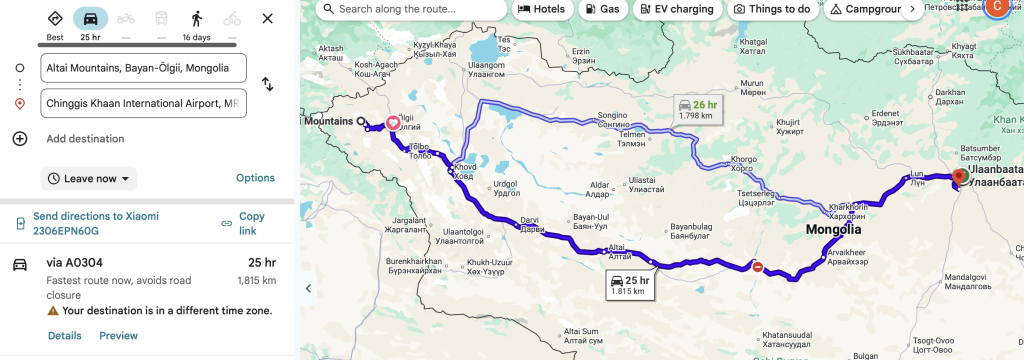
The Altai mountains in western Mongolia are a long way from the Mongolian capital, and I had no idea how to get there. The routes I read about were confusing, so I joined an open trip. It was organised by Rani (@rantje on Instagram), and it was a good decision for a first timer in Mongolia. Here is how the journey went, step by step.
Why an open trip
The hard part of Mongolia is not the sightseeing but the transport from Ulaanbaatar to Bayan Olgii. The yearly Golden Eagle Festival is a high season where all of the domestic flights can be sold out. When this happens, either we rent a car or take a bus to go the Altai Mountains. Joining a group meant someone else had already worked out the connections.
What it cost
I paid a total of IDR 23 million to Rani. That figure includes the Beijing to Ulaanbaatar flight on MIAT, which cost about IDR 6 million by itself. It also includes lodging, transport, guides, and festival tickets. Food is with ourselves, either we eat local food, or bring Indonesian dried foods that is more taste friendly to us. Please note that this is a very very cheap version of this trip since we are staying at local houses and even brought our own sleeping bag.
How much do other Golden Eagle Festival tours cost?
Operator and tour
Price per person
Approx. IDR
What the listing says
Source
Discover Altai, 7 days (1-7 Oct 2026)
from USD 990
16 million
Festival tickets and a stay with an eagle hunter’s family are included; international airfare is not
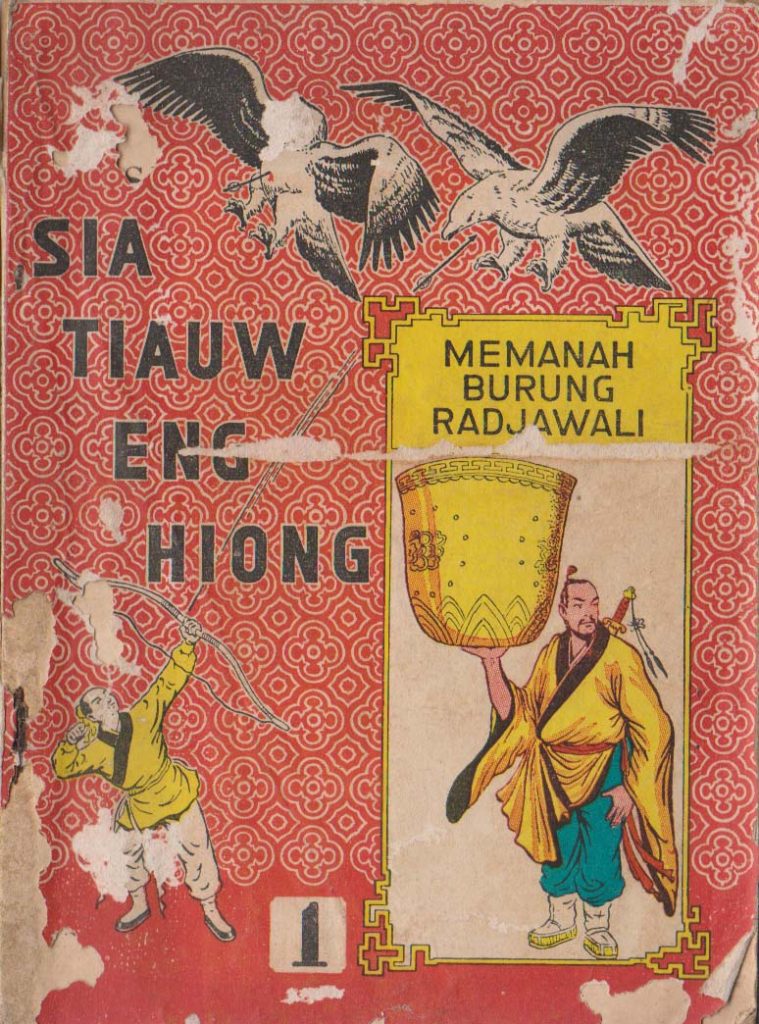
I didn’t go to Mongolia because of a travel list. I went because of a book my father bought me when I was a child.
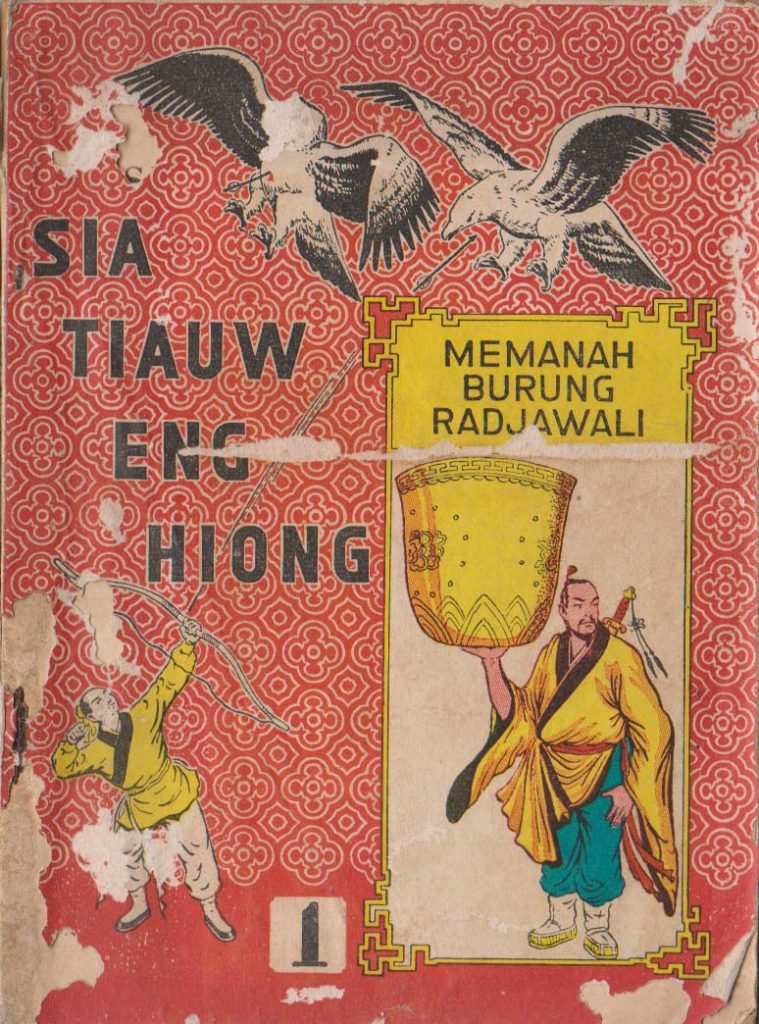
He found it at Kramat, in an Ejaan Lama (old spelling) book, the kind where the “j” is still “dj”. 1
The title was Sia Tiauw Eng Hiong, which most of the world now knows as The Legend of the Condor Heroes, by Louis Cha (Chin Yung). The names in my copy were in Hokkien, so the hero was Kwee Ceng, not Guo Jing as he is in Mandarin. To me he will always be Kwee Ceng.2
A boy raised on the steppe
In the novel, Kwee Ceng grows up in Mongolia from early childhood into his teens, living with his mother in a yurt. He becomes sworn brother (anda) to Tolui, the son of Genghis Khan and the future father of Kublai Khan.3 Genghis Khan promises Kwee Ceng in marriage to his daughter, Gochin/Huazheng. I read those chapters over and over, and I imagined a huge sky, endless grass, and a life that moved with the seasons.
Betamax from Jatinegara
Later came the 1980s TV series, on rented Betamax tapes from a shop in Jatinegara. Wong Yat Wa played Kwee Ceng, and the late Ang Mei Ling played Oey Yong.
The novel’s title means “shooting the eagle,” from the scene where Kwee Ceng brings down two great birds with a single arrow. Decades later I stood at the Golden Eagle Festival in Bayan Olgii, where nobody shoots eagles. The hunters ride out with eagles on their arms. It is the same drama, in reverse. I also thought of the white eagles that Kwee Ceng and Gochin keep in the story.
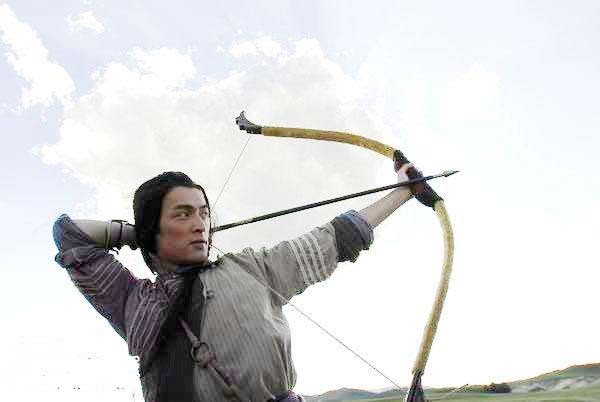
In every version of the series, there will be Kwee Ceng pose with arrow.
This is Hu Ge version. (2008):
Ci Sa version (2026):
What is real and what is not
Because this blog will mix history and fiction, I’ll mark the line clearly in every post.
Real: Genghis Khan, Tolui, and Kublai Khan, plus the world of the Mongol tribes and the campaigns to the west.
Invented by Louis Cha: Kwee Ceng himself, Gochin, and the friendship and romance that hold the story together.
One more caution: the eagle hunters in Bayan Olgii are mostly ethnic Kazakh, not Mongol. Hunting with eagles is a Kazakh Altai tradition.
What’s coming
Next, I’ll write about my adventures in Mongolia between 26 September and 8 October 2026. The story starts with the road from Jakarta to Ulaanbaatar and the long bus ride to Bayan Olgii. After that come the eagle hunter family in Tsengel, the Altai mountains, the Golden Eagle Festival, and finally Ulaanbaatar, with museums and all.
If you have ever read these books or watched the series, tell me which one stayed with you the most.
Look at the cover of this book. The title is Sia Tiauw Eng Hiong, and the subtitle says Memanah Burung Radjawali, “Shooting the Eagle.” Today, an Indonesian would write that last word as rajawali. The “dj” is a fossil, and it tells you roughly when this book was printed.
It turns out Indonesian has gone through several spelling systems in the last century, and you can date an old book by the letters alone.
Generation one: Van Ophuijsen (1901)
The first official system was designed by a Dutch scholar, Charles van Ophuijsen, and it was written for Dutch eyes. That is why the “u” sound was written oe, as in Dutch. Soekarno, boekoe, roemah. The consonants also followed Dutch habits: dj, tj, j for the “y” sound, nj, sj. 1
Generation two: the Republican spelling (1947)
After independence, the “oe” was dropped and replaced with a plain u. Soekarno became Sukarno. But the consonants stayed the same, so djalan and tjinta were still written the old way. My book belongs to this generation: “Burung” has a normal u, but “Radjawali” still has its dj.
Generation three: EYD (1972)
In 1972 Indonesia introduced the Ejaan yang Disempurnakan (the “Perfected Spelling”), usually shortened to EYD. It removed the last Dutch habits, and it came with a Malaysian counterpart so the two countries could share one system. 2
Here is the full comparison:
Sound
Van Ophuijsen (1901)
Republican (1947)
EYD (1972)
u
oe (boekoe)
u (buku)
u
j
dj (djalan)
dj (djalan)
j (jalan)
c
tj (tjinta)
tj (tjinta)
c (cinta)
y
j (jang)
j (jang)
y (yang)
ny
nj (njanji)
nj (njanji)
ny (nyanyi)
sy
sj (sjarat)
sj (sjarat)
sy (syarat)
kh
ch (chusus)
ch (chusus)
kh (khusus)
A few more details
The 1901 system also used apostrophes for glottal stops, as in ma’af.
Under the Republican spelling, repeated words could be written with a “2”, like anak2 for anak-anak. You can still see this in old handwriting and in text messages today.
The letters f, v, and z were officially recognised as part of the Indonesian alphabet in the 1972 reform.
How to date an old book
If you find “oe” in a book, it was probably printed before 1947. If you find a normal “u” but still see “dj” or “tj”, it is probably between 1947 and 1972. If it has “j” and “c” like we write today, it is from 1972 or later. This is only a rough rule, because printers did not always switch on the same day, but it is a good first clue.
The names are in Hokkien, too
The spelling of the names is another layer. In my childhood the hero is Kwee Ceng, the Hokkien reading of the characters that Mandarin speakers pronounce Guo Jing (郭靖). Indonesian translators of that era, many of them Chinese-Indonesian, used Hokkien because that was the dialect most of their readers spoke at home. The title itself, Sia Tiauw Eng Hiong, is the same phrase as the Mandarin Shè Diāo Yīngxióng (射鵰英雄)
Some passages bother us on first read. Matthew 20:1-16, the parable of the workers in the vineyard, is one of them. Workers who put in a full day get paid the same as those who showed up for the last hour. It feels unfair, and that discomfort is the point.
The Parable in Brief
A landowner hires workers at different times of the day, from early morning to the eleventh hour. At the end of the day, everyone receives one denarius. The first workers grumble, but the landowner reminds them that they were paid exactly what they agreed to, and asks, “Are you envious because I am generous?” (v. 15).
A few key takeaways:
It’s about the Kingdom, not the order of death. The parable opens with “the kingdom of heaven is like…” and it’s about when people are called, not when they die.
The denarius (dinar) is a gift. It is usually read as salvation, which can’t be earned by hours worked (Eph. 2:8-9).
Grace doesn’t cancel our response. Every worker still went to the vineyard. Grace doesn’t make our response unnecessary, but it changes the reason for it: we follow because we’ve been called and welcomed, not to earn a place.
The context matters. The parable answers Peter’s question in Matthew 19:27, “We’ve left everything, so what do we get?” No one should feel entitled to more because they’ve served longer.
Nobody is cheated. The first workers received exactly what was promised. Their complaint only appeared when they compared themselves with others.
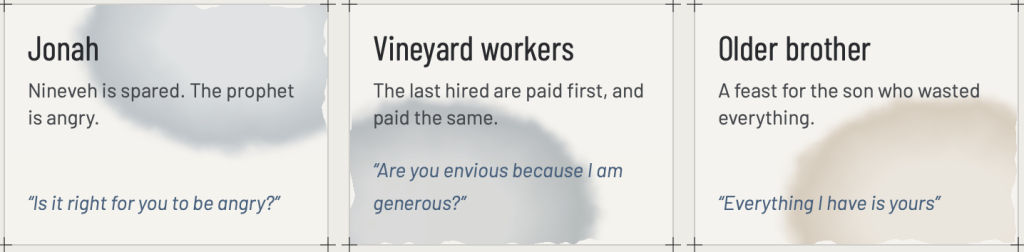
Three Stories, One Question
The same pattern appears in two other places in Scripture: Jonah (3:10-4:11) and the older brother in the parable of the lost son (Luke 15:25-32). In each, someone who has been “faithful” gets upset when God’s mercy reaches someone they consider undeserving.
Aspect
Jonah 3:10-4:11
Vineyard Workers (Matt. 20:1-16)
Older Brother (Luke 15:25-32)
Who objects
Jonah
The workers hired first
The older son
Who receives mercy
Nineveh
The eleventh-hour workers
The wayward younger brother
Who is generous
God
The landowner
The father
Form of mercy
Judgment withheld (3:10)
Full wage, one denarius
Welcomed home with a feast
Reason for complaint
Nineveh doesn’t deserve forgiveness
Those who worked less are paid the same
A reckless son is celebrated
The flawed perspective
Treating God’s blessing as exclusive
Comparing oneself with others
Seeing oneself as a servant, not a son
Key question / answer
“Is it right for you to be angry?” (4:4, 4:11)
“Are you envious because I am generous?” (20:15)
“Everything I have is yours” (15:31)
Who was not actually harmed
Jonah
First workers (paid what was agreed)
The older son (his inheritance is intact)
How the story ends
Open-ended, ends with a question
Open-ended
Open-ended
Core message
God’s love goes beyond national borders
Salvation is grace, not wages
We are children, not hired hands
The most striking row is the last-but-one: all three stories end without an answer. The reader is left to decide whether to join the celebration.
God Is for Everyone
Jonah’s anger reveals something important. Israel was chosen not as a privilege to hoard but as a channel of blessing to other nations (Gen. 12:3; Isa. 49:6). Jonah forgot that, and he was upset when the blessing reached Nineveh. Peter had to learn the same thing in Acts 10:34-35.
“Universal” means the invitation is open to all, not that everyone automatically enters. Like the workers in the vineyard, people still have to respond to the call.
Jonah: A Friend Who Argues
Jonah’s relationship with God is surprisingly close. He runs away (1:3), argues openly (4:2), and even asks to die (4:3). Only someone who knows God well would dare to speak like that: he admits he knew God was gracious and compassionate, and that was exactly what frustrated him.
What stands out is God’s response. There is no punishment, only patient questions and a plant to teach him (4:6-10). Scripture seems to treat honest complaint as part of a real relationship, as with Moses, Jeremiah, Job, and the psalmists. But Jonah is still corrected. We can be honest about our feelings, and our hearts still need to be straightened out.
What About the Workplace?
Can we apply this to unfair pay at work? Carefully. Jesus uses a work scenario as a picture of the Kingdom, not as a model for payroll. Two things stand out:
Comparison breeds resentment. The first workers had no complaint until they looked at someone else’s pay.
The latecomers weren’t lazy. They said, “No one hired us” (v. 7). They were willing but hadn’t had the chance.
Scripture also cares about fair wages (Deut. 24:14-15; James 5:4; Col. 4:1) and about diligence (2 Thess. 3:10). Real injustice at work is still worth addressing. The parable simply teaches a heart attitude, not a pay structure.
Conclusion
Three stories ask one question: Can we rejoice when God is generous to someone else?
If we see ourselves as employees earning our place, we’ll keep counting and comparing. If we see ourselves as those who were called and welcomed by grace, we can join the feast.
A Personal Reflection: I Struggle with This Too
I’ll be honest: I get envious. When someone else receives a blessing, a break, or a celebration I was hoping for, my first reaction is often not joy. It’s a quiet, sour “what about me?”
That’s why these three stories hit close to home. Jonah, the first workers, and the older brother weren’t villains. They were faithful people, and they still struggled to rejoice when God was generous to someone else. Somehow that comforts me. Envy doesn’t mean my faith has failed. It means my heart still needs straightening out, just as Jonah’s did.
Here is what I’m learning to practice:
Notice when the comparison starts. The first workers had no complaint until they saw someone else’s pay. When envy shows up, I ask myself: Am I actually lacking something, or am I just comparing?
Remember what I already have. The older brother was told, “Everything I have is yours” (Luke 15:31). He was already rich and didn’t realize it. Envy tends to make me blind to what’s already been given.
Pray for the person. It feels awkward at first, but asking God to bless the person I envy slowly changes how I see them. Romans 12:15 calls us to rejoice with those who rejoice. That takes practice; it doesn’t come naturally.
Measure my own work. Galatians 6:4 invites us to test our own work rather than measure ourselves against someone else.
Be honest with God. Jonah didn’t pretend to be happy. He told God exactly how he felt, and God answered with patience and questions, not punishment. “God, I’m envious” is a better prayer than silence.
Sometimes envy also points to a desire I haven’t admitted yet. Instead of only fighting it as sin, I can bring that desire to God and let Him speak to it.
So the question stays with me, and I’ll leave it with you too: Can I rejoice when God is generous to someone else? I’m not there yet. But I’d rather be honest and still learning than pretending I’ve already arrived.
One of the more disorienting things about reading the Bible closely is realizing how rarely it hands you a verdict. We come to the text looking for a moral scorecard — was this person good, or bad? — and the text mostly refuses to answer.
Take Moses. Exodus 2:11-12. Before he becomes the man who leads Israel out of Egypt, he kills an Egyptian overseer for beating a Hebrew slave. The narrative doesn’t pause to rule on it. It doesn’t say “this was righteous zeal” because the act is for his people and it doesn’t say “this was murder, full stop.” It simply tells you what happened next: Moses is found out, and he flees into the wilderness of Midian.
That flight looks, on the surface, like punishment — exile, loss of status, a man running for his life. But it’s also where the next chapter of his story actually begins. At a well in Midian, he helps the daughters of a priest water their flock, and through that encounter he meets Zipporah, who becomes his wife. The very consequence that looks like ruin turns out to be the doorway into the next stage of his formation — years of quiet, obscurity, and shepherding that shape him long before he ever stands in front of Pharaoh.
The pattern worth noticing: Scripture tends to narrate consequence, not character rating.
It doesn’t stamp people “good” or “bad” and move on. It shows what they did, and it shows what followed — and it trusts the reader to sit with the ambiguity rather than resolve it for them.
What the text does seem to care about, consistently, is something different from moral scorekeeping: humility and surrender before God. Not innocence. Not a clean record. The people the Bible holds up aren’t the ones who never did wrong — they’re the ones who, wrong and all, kept turning back. That’s the whole logic of grace: it only makes sense as a response to people who need it, not to people who’ve earned a passing grade on their own.
So maybe the more honest way to read these stories isn’t “was this person good or evil,” but “what did this cost them, what did God do with it, and did they stay postured toward Him afterward.” Moses killed a man and ran. He also became the one through whom a nation was freed. Both things are true, and the Bible seems entirely comfortable leaving them both on the page, unresolved into a single verdict.



Leave a Reply