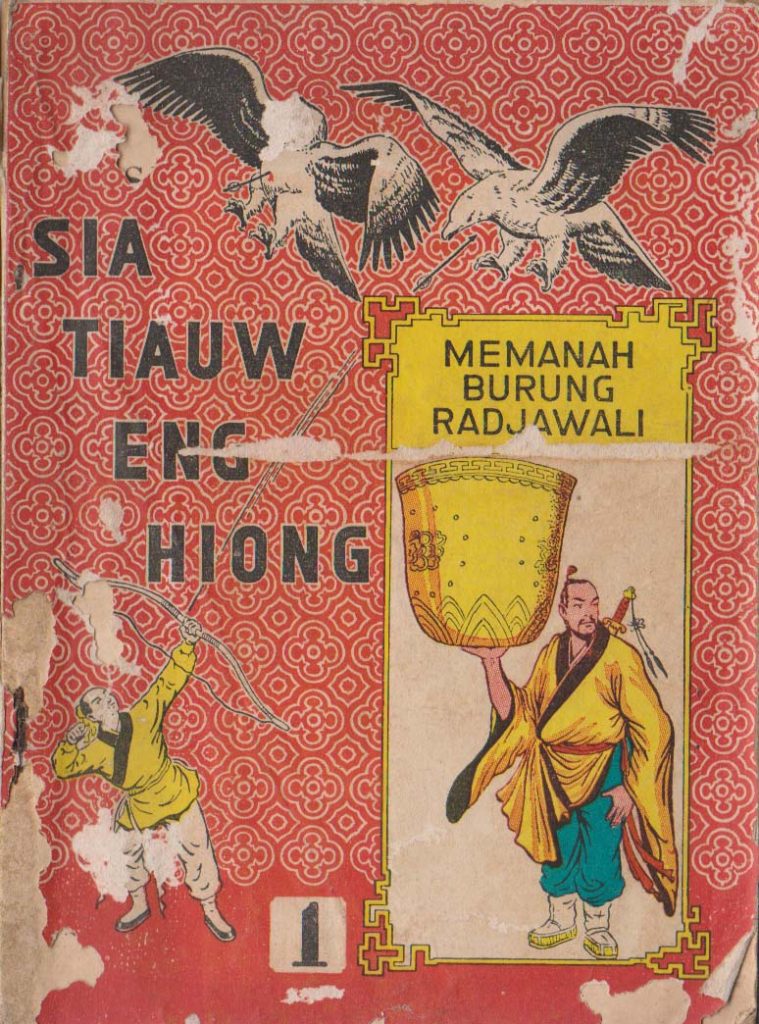
Look at the cover of this book. The title is Sia Tiauw Eng Hiong, and the subtitle says Memanah Burung Radjawali, “Shooting the Eagle.” Today, an Indonesian would write that last word as rajawali. The “dj” is a fossil, and it tells you roughly when this book was printed.
It turns out Indonesian has gone through several spelling systems in the last century, and you can date an old book by the letters alone.
Generation one: Van Ophuijsen (1901)
The first official system was designed by a Dutch scholar, Charles van Ophuijsen, and it was written for Dutch eyes. That is why the “u” sound was written oe, as in Dutch. Soekarno, boekoe, roemah. The consonants also followed Dutch habits: dj, tj, j for the “y” sound, nj, sj. 1
Generation two: the Republican spelling (1947)
After independence, the “oe” was dropped and replaced with a plain u. Soekarno became Sukarno. But the consonants stayed the same, so djalan and tjinta were still written the old way. My book belongs to this generation: “Burung” has a normal u, but “Radjawali” still has its dj.
Generation three: EYD (1972)
In 1972 Indonesia introduced the Ejaan yang Disempurnakan (the “Perfected Spelling”), usually shortened to EYD. It removed the last Dutch habits, and it came with a Malaysian counterpart so the two countries could share one system. 2
Here is the full comparison:
| Sound | Van Ophuijsen (1901) | Republican (1947) | EYD (1972) |
|---|---|---|---|
| u | oe (boekoe) | u (buku) | u |
| j | dj (djalan) | dj (djalan) | j (jalan) |
| c | tj (tjinta) | tj (tjinta) | c (cinta) |
| y | j (jang) | j (jang) | y (yang) |
| ny | nj (njanji) | nj (njanji) | ny (nyanyi) |
| sy | sj (sjarat) | sj (sjarat) | sy (syarat) |
| kh | ch (chusus) | ch (chusus) | kh (khusus) |
A few more details
- The 1901 system also used apostrophes for glottal stops, as in ma’af.
- Under the Republican spelling, repeated words could be written with a “2”, like anak2 for anak-anak. You can still see this in old handwriting and in text messages today.
- The letters f, v, and z were officially recognised as part of the Indonesian alphabet in the 1972 reform.
How to date an old book
If you find “oe” in a book, it was probably printed before 1947. If you find a normal “u” but still see “dj” or “tj”, it is probably between 1947 and 1972. If it has “j” and “c” like we write today, it is from 1972 or later. This is only a rough rule, because printers did not always switch on the same day, but it is a good first clue.
The names are in Hokkien, too
The spelling of the names is another layer. In my childhood the hero is Kwee Ceng, the Hokkien reading of the characters that Mandarin speakers pronounce Guo Jing (郭靖). Indonesian translators of that era, many of them Chinese-Indonesian, used Hokkien because that was the dialect most of their readers spoke at home. The title itself, Sia Tiauw Eng Hiong, is the same phrase as the Mandarin Shè Diāo Yīngxióng (射鵰英雄)
Leave a Reply